
PISA 2025: What the Results Mean for Your Child
Building strong foundations and independent learning habits from an early age
The latest PISA results give us reason to look more closely. Over the past ten years, performance in mathematics and reading has declined in Switzerland. A substantial proportion of 15-year-olds do not reach the baseline level of proficiency in these subjects. For parents, this raises a very practical question: Does my child have the foundations they need for the next stage of learning? These include both subject knowledge and the ability to plan tasks and gradually take greater responsibility for their own learning.
Both deserve attention early on. When difficulties only become apparent shortly before an important exam, children often have several things to catch up on at once. If learning revolves mainly around the next test over a longer period, their foundations can remain shaky and gaps can widen. Recognising recurring difficulties early gives parents, children and teachers the opportunity to work on them together.
What PISA tells us about foundational skills
A substantial proportion of young people do not reach baseline proficiency. The long-term trend is concerning.
The PISA 2025 results, published on 8 September 2026, show that Switzerland remains above the OECD average in mathematics, reading and science. However, performance in mathematics and reading has declined over the past ten years, while science performance has remained stable.
Swiss government and cantonal education authorities

Looking at baseline proficiency is particularly revealing. Around 23% of 15-year-olds in Switzerland perform below PISA Level 2 in mathematics, and around 29% in reading. Since 2015, these proportions have increased by seven and nine percentage points respectively. At Level 2, students can, for example, express a simple everyday situation mathematically or identify the main idea in a text of moderate length. Students below this threshold have not yet developed sufficient proficiency in these basic applications.
OECD country note: Switzerland
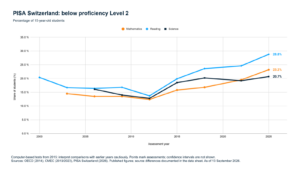
PISA assesses 15-year-olds. The results do not tell us when a particular gap developed or how well an individual school is performing. For us, however, the trend is a clear reason to pay closer attention to the foundations that successful learning depends on.
New difficulties can reveal older gaps
To understand new material, children need to draw on knowledge they already understand and can use confidently.
In our work at Upside Education, we often meet children and teenagers whose current difficulties are linked to gaps that have developed over months or even years. These frequently involve concepts from primary school that they continue to need throughout their education.
Fractions are a useful example. A secondary school student may understand the new method for solving an equation but get stuck as soon as fractions are involved. It then makes sense to revisit the underlying concepts, often taught in the fifth or sixth year of Swiss primary school: What does a fraction represent? Why does multiplying its numerator and denominator by the same number leave its value unchanged? How do fractions, decimals and percentages relate to one another, and how can we convert between them? How are fractions connected to division?
Research also highlights the importance of these foundations. A longitudinal study using data from the United States and the United Kingdom found that understanding fractions and division in primary school was associated with mathematics achievement five to six years later. This relationship remained after the researchers accounted for other differences between the children.
Siegler and colleagues, 2012
Reading offers a similar example. A child who struggles to understand an informational text must also work harder to make sense of the reading material in history or science. This leaves less attention available for the question they are actually trying to answer.
Foundational skills therefore need to be revisited regularly, explained and applied in different tasks, whatever the child’s age. Many are first developed in primary school and strengthened in secondary school. If gaps become apparent later, addressing them remains an essential part of learning.
Planning and organisation need guided practice
Calendars, homework diaries and study plans are useful tools. Children still need to learn how to use them effectively.
As children get older, they are expected to take on more responsibility: keeping track of homework, having the right materials ready and preparing for tests. These expectations depend on skills that need to be deliberately practised in everyday life.
This can begin in simple ways during primary school. Before starting homework, a child can look at what needs doing with an adult and decide where to begin. Later, they can practise estimating how long tasks will take and spreading preparation across several days. The amount of guidance they need depends on their stage of development and previous experience.
An upcoming test offers a practical opportunity to work through these steps:
- Clarify what is involved: Which topics will be covered? What do I already understand? What do I still need to practise?
- Break the work down: Which manageable task will I work on each day?
- Check understanding: Can I solve a problem without a worked example and explain my approach?
- Reflect afterwards: What worked well? What will I change next time?
Drawing on research, the Education Endowment Foundation recommends explicitly teaching children how to plan, monitor and evaluate their learning, and practising these skills within the subjects they are studying.
EEF guidance report
Starting early creates opportunities to practise before demands increase. Teenagers in their second or third year of secondary school can still develop these skills. They need clear, manageable steps and support that is gradually reduced as their confidence grows.
When parents should take a closer look
Recurring difficulties are a reason to explore the underlying cause together.
A single disappointing grade tells us little about whether a child has gaps in their foundational skills. Patterns that emerge over time are more revealing. For example:
- Your child repeatedly makes the same basic mistake in similar tasks.
- They can complete a task by following an example but struggle to explain the method or apply it to a slightly different problem.
- They read a text but then find it difficult to explain its content in their own words.
- They regularly lose track of what needs doing or struggle to get started, even with agreed support in place.
These observations can have different explanations. A calm conversation can help you understand more: “Show me how far you get before it becomes difficult.” Or: “What is making it hard to get started?” Questions about the underlying concepts, such as “Can you explain what a fraction means?”, can also help reveal possible gaps. If a pattern keeps recurring, bring specific examples to a conversation with your child’s teacher. Together, you can work out what your child needs.
How support helps children become more independent
Effective support addresses a specific difficulty and helps the child take the next step themselves.
The starting point is to establish as clearly as possible what the child already understands. With fractions, for example, they may be able to compare values but still be unsure how to create equivalent fractions. This gives them a manageable learning goal. Afterwards, you can check together whether they can explain what they have learnt and apply it to new tasks.
The same principle applies to organisation. At first, you might plan the next two afternoons together. Later, your child can suggest their own plan for you to discuss. As they become more confident, they take on more responsibility. Support should match their actual needs and be coordinated with the school. If difficulties persist, additional specialist support may be helpful.
At Upside Education, we therefore combine work on gaps in subject knowledge with study planning and regular feedback on progress. We focus on what a child now understands and how they can gradually take greater ownership of their learning.
Key takeaways
- Strong foundations matter.
New learning builds on knowledge children already understand. - Look beyond the current topic.
Today’s difficulties may reveal gaps from earlier school years. - Planning takes practice.
Children need guidance to learn how to organise their work. - Notice recurring patterns.
Specific observations help parents and teachers identify what a child needs. - Build independence gradually.
Adapt support as children become more confident and capable.
Looking closely and offering the right support
For parents, the first step can be a small one. Ask your child to explain a task they are working on. Listen for what they understand confidently and where they get stuck. This often leads to a more helpful question than “Have you studied enough?”
What do you need to take the next step? Book a free consultation now.
Sources
SERI and EDK (2026) OECD publishes the PISA 2025 results
Swiss government press release, 8 September 2026. Available in German.
OECD (2026) PISA 2025 Results, Volume I: Country Note — Switzerland
Siegler, R. S., et al. (2012) Early Predictors of High School Mathematics Achievement
Psychological Science, 23(7), 691–697.
Education Endowment Foundation Metacognition and Self-Regulated Learning
Evidence-informed guidance on helping pupils plan, monitor and evaluate their learning.